Tuesday, August 26, 2025

If You Build It, They Will Come


One of my favorite movies growing up was Field of Dreams. The whole idea is that if you’re persistent and keep at it, change will eventually come. That’s where the famous line comes from: “If you build it, they will come.” How wonderful that I get to use this phrase for our work!

Over the years I’ve been part of projects I’m proud of, but one of the most formative was volunteering with Relay for Life through the American Cancer Society. If you’re unfamiliar, Relay began in 1985 in Tacoma, Washington, when Dr. Gordy Klatt walked and ran a track for 24 hours, raising $27,000 for cancer research. From there it grew into a national tradition. 

My family got involved after my grandfather passed away from cancer, and as a teenager, I jumped in. I volunteered at the Christmas Expo, then helped launch a Home and Garden Expo with friends. We had no money, no training, and no connections—just a lot of determination. But we built something out of nothing and raised $25,000 a year. Soon we were being asked to coordinate more events, like a fashion expo. I became known as “the auction guy” because my auctions always pulled in a crowd. That’s when I first realized: if you build it, they really do come.

Of course, it wasn’t always smooth. Some Relayers would host events and feel defeated when nobody showed up. My job as Retention Chair was to remind them: success comes when people feel heard, welcomed, and part of something bigger. That’s what kept people coming back year after year. My team of friends and I won the Gordy Klatt award one year, the first team to win the award. We were honored! 

Fast forward to today, and I see the same lessons in my work with disability advocacy. Becoming Director of Disability Access in Prison Education didn’t happen overnight. It took countless rejections, endless submissions, and constant effort to collaborate and make my voice heard. But by keeping at it, I was able to create things like the Stop the Stigma conference and partnerships with organizations like JSTOR. The same principle applied: build it, and eventually, people will show up.

Guess where I was just last week? Washington! It is such a beautiful state. We flew into Seattle and had the chance to drive out to Puget Sound and Grays Harbor—both absolutely stunning areas. One of the things that really stuck with me was how well they preserve their trees. Outside our hotel, there was this tree right in the middle of a busy area. It looked to be at least ten years old, and instead of cutting it down, they built everything around it. I loved that. It reminded me that preservation—of nature, of people’s voices, of access—really matters.

During that visit, Dr. Jenifer Montag and I trained about twenty staff from college and vocational programs, joined by Department of Corrections staff and a Disability Services coordinator. Everyone had a voice at the table. Everyone felt included. That sense of teamwork reminded me so much of my Relay years.

Back then, my closest friends-- Sidonie, Henrietta, Mark, Alfie-- and I never lost sight of what mattered: communication, acceptance, making sure everyone felt heard. Seventeen years later, we’re still very close. And that’s exactly the spirit that makes both fundraising and disability advocacy successful.

At the heart of it all, whether it’s Relay or disability access, the question is the same: Are people being heard? Are they accepted? Do they feel valued? When the answer is yes, the results follow.

That’s how we raised money for cancer research. That’s how Washington programs are making education more inclusive. And that’s how I got where I am today.

Because if you build it, they will come.

Wednesday, July 30, 2025

Conversations, Collaboration, and a Portable Fan: Three Weeks of Disability Advocacy


Hello, everyone!

Apologies for not writing sooner—it’s been a whirlwind these last three weeks! I was talking to my friends Jenny and Debbie last night and said it feels like we’re so high up, the only way to go is down. Of course, that’s the pessimistic part of me talking, because the truth is, we’re just getting started.

Three weeks ago, I had the honor and pleasure of attending the AHEAD conference in Denver, Colorado. AHEAD is the national organization we’ve partnered with through our disability access grant, working alongside Dr. Jenifer Montag. One of the key lessons I’ve been emphasizing as we build out our training manual is that collaboration is essential. Up to now, my work has primarily been on the corrections side—but not as much on the disability services side. And there’s a gap there. A gap that shouldn’t exist.

All students deserve access to quality education and support, whether or not they have a disability, and whether or not they’re incarcerated. When we work together—disability services, corrections, education partners—everyone benefits. At AHEAD, I made some powerful connections, including with the National Deaf Center, who is excited to learn more about our work and explore future collaboration. The AHEAD conference leads by example when it comes to equal access, and I left inspired to continue pushing for that same equity for incarcerated students.

The following week, we hit the road—North Carolina, Georgia, South Carolina, and Florida. Huge shout-out to Jenny for being willing to drive all of it! We had a rental car that started with just 4 miles on it, and by the end of the trip we had clocked over 1,000. One highlight was meeting with the Florida Coalition for Higher Education in Prison. They’re eager to learn how they can better support students with disabilities, and we talked about the importance of planning for reentry. Depending on the study, 90–95% of incarcerated people will come home—and we need to make sure they’re ready. Florida is a great example of what’s possible when passion and purpose come together to create change.

Now let’s talk about heat. Needless to say, it was blazing hot in all four states we visited! We did a quick side trip to Savannah, Georgia—an incredible city full of powerful and, at times, painful history. With heat indexes well over 100 degrees, we had to be smart about our time. I carried a portable fan, wore sunscreen and breathable clothes, stayed hydrated, and took AC breaks whenever we could.

But that brings me to a bigger issue. Extreme heat (and cold) can be serious triggers for people with disabilities—especially those with multiple sclerosis (MS), asthma, cardiovascular conditions, epilepsy, and certain mental health disorders. For example, MS symptoms can worsen dramatically in heat, and heat-related stress can amplify anxiety or make it harder to regulate medications.

Many correctional facilities, unfortunately, don’t have air conditioning or adequate heating—not in classrooms, and often not in dorms or general areas either. I recently spoke with someone incarcerated who shared that in his state, they've been promising AC for years—but nothing has changed. As a cost-saving measure, they installed industrial fans in the common rooms, but not where people sleep. The result? Students are getting sick, exhausted, and unable to focus in class.

Now imagine trying to learn algebra or business accounting while it’s 100 degrees and there's no AC. Even for those without disabilities, that’s a tough environment. For students with sensory processing disorders, chronic illness, or fatigue-related disabilities, it’s even more dangerous and limiting. Instructors suffer too—many have strict dress codes barring shorts or open-toed shoes, making the conditions even more unbearable.

This is why partnerships and collaboration matter so much. Universities and education programs can play a vital role in helping Departments of Corrections understand that investing in accessible, climate-controlled spaces isn’t just humane—it’s essential for student success.

That was one of the biggest takeaways from this trip. I’m especially excited about our next step: creating a training manual and a series of online modules that offer practical strategies for DOCs and programs—especially when facilities lack proper heating or cooling. Instead of denying students participation because of the physical environment, let’s figure out how they can participate safely and successfully.

I’m home for two weeks now, then I’m off to Washington State—and I’m excited! I’m deeply grateful to everyone in Florida, Georgia, South Carolina, and North Carolina for the warmth (pun intended), the conversations, and the commitment to change. It’s a lot of travel, yes—but the connections we’re making and the momentum we’re building make it more than worth it.

Thanks for following along. We’re just getting started—and I’m so glad you’re with us.

Friday, June 27, 2025

Justice, Identity, and the People Who Keep Me Going


Hello everyone! I'm currently in the great state of Wisconsin. As many of you know, The Community is based in Milwaukee. Twenty years ago, I worked at a camp in the Wisconsin Dells and visited Madison a few times, but this is actually my first time in Milwaukee! I also had the opportunity to return to Madison—and it didn’t take long to remember why I love this state. Both cities felt so open and welcoming.

While in Madison, I visited a bookstore called A Room of One’s Own, and it almost screamed equality. The store made it clear that everyone was welcome, regardless of who they were. I was especially pleased (and surprised!) to find an entire section dedicated to abolition and prisoner rights, including a proud display of support for LGBT Books to Prisoners. Even though many Wisconsin prisons have recently banned incoming books or packages, LGBT Books to Prisoners hasn’t backed down from their mission to provide resources to incarcerated LGBTQ+ individuals.

On that visit, I also learned something new—there’s a Disability Pride Flag! I showed it to Dr. Montag, and she laughed and said I must’ve been living under a rock. 😆 Honestly, I couldn’t believe I hadn’t come across it sooner!

As a quick disclaimer: when we conduct site visits or trainings, I won’t be naming specific institutions, but I will share insights by state. We had several meaningful visits here in Wisconsin, and I’m incredibly excited about the training manual we’re developing for staff and faculty in higher ed prison programs. One of our grant goals is to increase the number of students with disabilities who complete their programs—and we believe this work will ripple outward, eventually becoming a wave of transformation.

Two themes have come up at nearly every visit Dr. Montag and I have had:

  1. “If you build it, they will come.” Dr. Montag began her work in one prison with a single student who needed accommodations. As she made her presence more known, that number grew—to 45 students. Likewise, this project started with a few connections and now spans over 30 states, countries, and territories. That’s incredible.

  2. Hidden disabilities are everywhere. Most people entering prison lack strong educational backgrounds. Many likely have undiagnosed or unrecognized disabilities. Did they ever get evaluated? We may never know. I often compare it to needing glasses—I once drove around thinking I was fine. Then I got new lenses and realized how bad my vision really was. The optometrist even asked, “How were you driving like this?” That’s what it’s like for many people in prison. It’s not that they don’t want to read—they may just never have been given the tools or supports (like my glasses) to learn how.

My week ended with an incredible panel hosted by JustDane in Madison. Four amazing individuals shared their experiences as LGBTQ+ people impacted by incarceration. These stories can be heavy—there’s so much work to be done—but I walked away with hope. One panelist, Kai, shared her experience being misgendered over and over again in a men’s prison. It was deeply damaging. But now she’s out, living proudly and building her life in Madison. It’s people like Kai, Tarah, and Kelsey who remind me why we do what we do: for dignity, for justice, for humanity.

Thank you, Wisconsin, for your hospitality. I’ll be back.

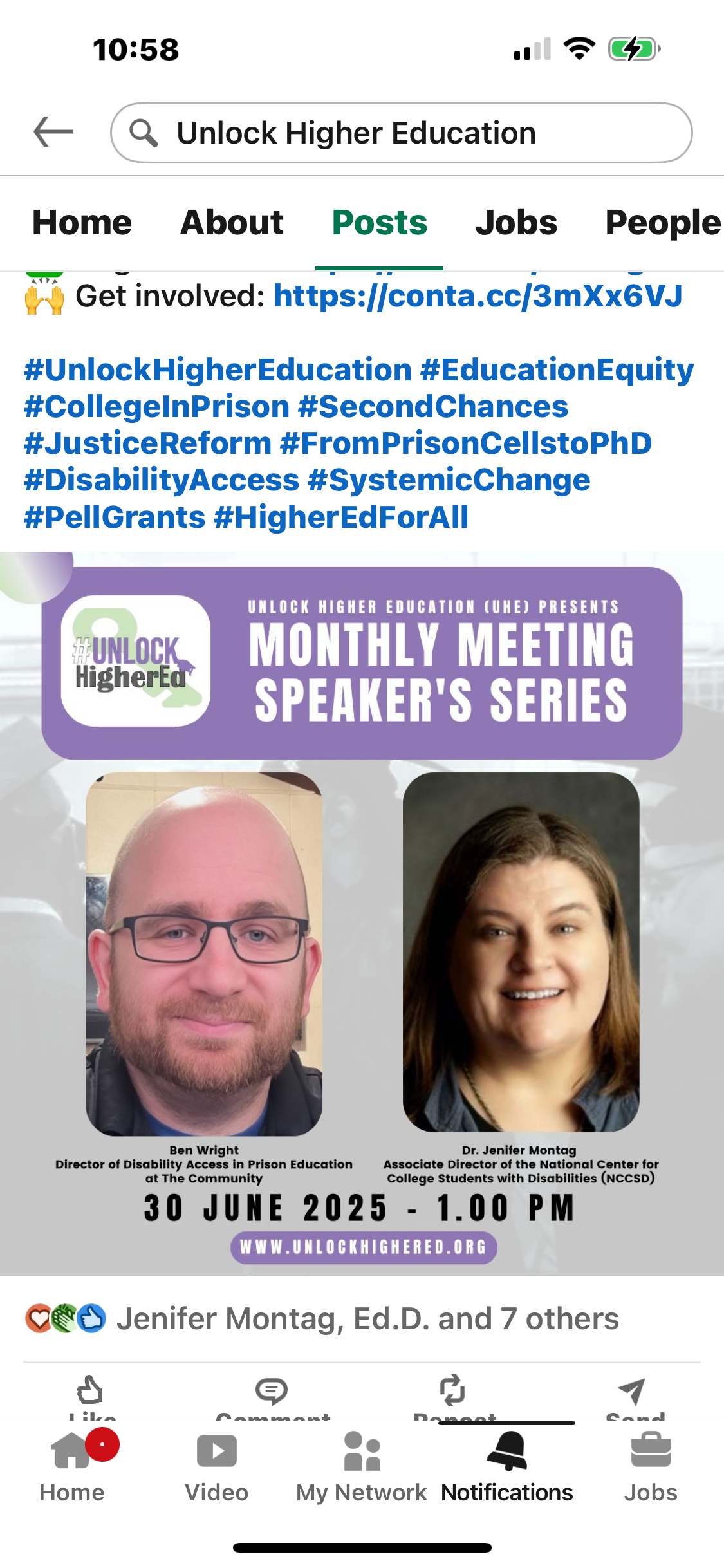
See you on the 30th (next Monday) at 1pm for our talk with Unlock Higher Education ! Register here :)


Tuesday, June 17, 2025

Beyond the Numbers: What JFF’s Horizons Conference Means for Prison Education and Reentry


Photo credit: Rebecca Villarreal


Hi all!

Part of my job at The Community is to correspond with individuals who are incarcerated in the state of Wisconsin. I also communicate with several people from Ohio. While this began as part of my Communications role, I chose to continue this work even after transitioning into my current position as Director of Disability Access in Prison Education.

Many of the people I write to express feelings of hopelessness: “I can’t do it,” “There’s no hope for me when I get out,” and so on. And honestly? I get it. I don’t always know what to say. The statistics are discouraging. According to one study, about 39% of people incarcerated in state facilities return to prison within three years. Only 40% of formerly incarcerated individuals have gainful employment (though I often wonder how “gainful” is actually defined). One study out of Cornell reported that 66% of incarcerated individuals self-report having a disability. The numbers vary depending on the source, but the overall picture doesn’t look promising.

So how do we respond? How do we encourage people who are staring down numbers like that—people who have been incarcerated for 15 or even 20 years, preparing for release with little to no family left, few financial resources, and no clear direction?

How do we offer hope without sounding like a cliché? “Don’t give up!” “Try hard and you’ll succeed!” “Good things come to those who wait!” These statements, while well-meaning, often fall flat. On the flip side, I don’t want to be a Debbie Downer either.

Last week, I had the opportunity to attend the Horizons conference hosted by Jobs for the Future (JFF). JFF has a division called the Center for Justice and Economic Advancement (CJEA), which is committed to breaking down systemic barriers and advancing fair chance employment for people with criminal records. JFF is also doing groundbreaking work around AI, North Star credentialing, and more. I’m continually impressed that they boldly and publicly support CJEA, even when so many organizations still shy away from justice-focused efforts.

During a main stage session with over 1,500 attendees—from institutions, nonprofits, corporations, and more—JFF proudly highlighted CJEA and invited Molly Lasagna, Susan Burton, Lucretia Murphy, and Darvelle Hutchins to speak. These four are giants in the field. I’ve admired Susan and Molly’s work for years, and Lucretia and Darvelle are true pioneers. If you don’t know who they are, take a moment to look them up—you won’t regret it. I got to buy Susan's book, too! 

In addition to the main session, I attended breakouts focused on fair chance employment, including one with a representative from the Port Authority (yes, the one known for its rigorous security checks) and a professor from Belize doing powerful comparative work. JFF also introduced seven ambassadors from CJEA, all formerly incarcerated individuals now leading in their fields.

I’ll be honest—there were moments I felt like a fish out of water. I felt that way last year, too. But here’s what I’ve realized: I belong there. I was in that room with governors, CEOs, university administrators, and yes, folks like me. I attended sessions on AI, disability, and justice just like the executives sitting next to me.

I’m especially grateful to Rebecca Villarreal and Jenna Dreier, whose passion for this work is unmatched. JFF backs up their values with action. They’ve even hired Shaun Libby, a currently incarcerated individual, as a manager on staff. They’ve made it work—despite the challenges—and most importantly, they’ve treated him like an equal member of the team. He’s building savings. When he comes home, he won’t be starting from scratch.

One of my personal heroes is Dolly Parton, and her words feel relevant here:

“If your actions create a legacy that inspires others to dream more, learn more, do more, and become more, then you are an excellent leader.”

That’s exactly what CJEA is doing.
They empower people to dream more by showing them a future is possible.
They help us learn more by educating the public and stakeholders.
They equip people to do more by building networks and hiring directly from impacted communities.
They help others become more by producing results—not just rhetoric.

Do you see where I’m going with this?

When incarcerated individuals write to me, I want to point to something real—something tangible, something practical. Instead of saying, “If I can do it, you can too,” I want to say, “Look at what JFF and CJEA are doing. There’s a model out there. There’s hope—and here’s what it looks like in action.”

And that’s what I hope to accomplish with our disability access project too. I want to be able to say, “Here’s what we’re building for you. Here’s how we’re creating access to education and employment.” Everyone deserves the chance to be an engaged, contributing member of their community. This is how we start.

Also—on a lighter note—I had an amazing time in New Orleans! We went on a riverboat, took a swamp tour (airboats are wild!), explored the French Market, and of course, wandered up and down Bourbon Street. If you go, take a riverboat tour—you won’t regret it!

To Molly, Susan, Darvelle, Lucretia, Rebecca, Jenna, Linette, Maria, Michael, Shaun, and so many others I’m forgetting to name here—thank you for making Horizons such a rewarding and revitalizing experience.

Friday, June 6, 2025

The Power of Voice, the Strength of a Team: Reporting from NASFAA-PEP


Hi all!

I’m reporting from Washington, DC! I have always loved this city—I love the history and all the stories behind every museum here. Unfortunately, there was no time to go exploring in any of the museums—the NASFAA (National Association of Student Financial Aid Administrators)- PEP (Prison Education Program) took up all of my time. Honestly? It was a lot of fun! A lot of learning, and a lot of connections and networking.

The most important thing that I learned during this meeting was that everyone needs to work as a team. There were meetings about compliance, registration, distance learning, the FAFSA, even a listening session from the Department of Education. I walked away with the confidence that my message has been right all along—it takes a team to lead and facilitate a successful prison education program. Think about it—students on the outside have the freedom to register online, fill out the FAFSA online, request accommodations on campus—things like that. But what about incarcerated students? How are they registering? How are they filling out the FAFSA? How are they getting the accommodations they need? The big issue for me here is, we need to support our students so they have the best future they could possibly have. Victoria Scott and Stacy Burnett at the opening session talked about the power of voice and the power of education. The data shows it, too—recidivism rates go down when you have more education. Education not only gives you practical knowledge but gives you the confidence to be who you want to be. To be a good citizen. That, to me, is paramount.

I was on a panel with Adam Kasarda, Jenifer Montag, and Dominic Winter. They are all champions in the student disability service field, whether it be with a DOC (Department of corrections) or a university. Even though I’ve been on quite a few panels and given quite a few presentations, this one was a bit harder for me. I was giving a presentation about a month ago, and about halfway through the presentation, I decided it was important to disclose that I do, in fact, have lived experience. Some of the individuals in the audience looked crestfallen, dejected, or looked as if they pitied me. My “inner demon” so to speak could have been talking to me, telling me that they did that when they really didn’t—but either way, I felt rejected. I felt like I was suddenly not an expert in this field. So I told that story to this audience, and said- you know what? Stacy Burnett (who is my heroine and one of my biggest role models!) said to own myself for who I am. She said to own our voices, and make sure our voices are heard. So, darn it, I made sure my voice was heard. This time, I didn’t see anyone look crestfallen. A win!

My favorite part of the whole thing was seeing people I’ve been connecting with in person. I saw people from Virgina, Nevada, Maine, Maryland, Illinois, California, the New England area… It was pretty exciting. I really enjoy seeing people who have a common interest—our students.

Again, my key takeaway from the presentations was the sense of TEAM. Too often, I hear that certain offices are not involved in their prison education program. This creates a burden on the PEP coordinators, and on the students. If the registration office works with the financial aid office and works with the student disability services office and the PEPs… And they all work together… a lot more can get done, and more efficiently, too.

I continue to emphasize that I strongly believe being proactive rather than being reactive when it comes to providing accommodations is a key factor in all of this. It saves money, time, and allows for more students to feel relaxed in the classroom. Having a checklist of things to make sure your classroom has, communicating with your students on their needs, making sure no one feels less than or more than—it’s a long ride, but so worth it. If we just wait until someone complains, then we are being reactive—rather than clean up the mess (which is more costly), avoid the mess from happening in the first place.

It was a good trip. It was great to connect. Kudos to Sheila Meiman and her team for putting this together, and I love that Ascendium was a sponsor of this event. To all the presenters, you were fabulous! Thank you for teaching me so much. I hope I taught you something, too.

I want to end on a personal note. The panel I was on went very well. I have no doubt of that. Outside of my introduction I only spoke once, but that was because we had so much content in an hour… There’s no way to condense it into an hour. But after the panel, my emotions got the best of me—I was feeling anxious, down, sad. I went back to my laptop and just focused on it to not burst into tears. It was like my inner self telling me that I was inefficient, I shouldn’t have been there, etc. I hate when that feeling happens. The reason I’m sharing this is because I believe that post incarceration syndrome is a real thing—and it was as if my anxiety wanted to eat me alive. And for what? A great panel?

I am so thankful for this disability access project. I am so excited to start working with everyone. We start our pilot visits in Milwaukee, Wisconsin, which I am very excited about. It just so happens that Milwaukee is where The Community is located! I’ll finally get to see the team in person (although, we did just see each other in New Orleans in April!) In Washington DC I made several new contacts… I just know they will keep coming.

You know why? It’s because you KNOW all students are worth it.

Until next week! I'll be at the Horizons conference hosted by Jobs for the Future!! :) 


Wednesday, May 28, 2025

Beyond the Felony: Embracing Identity and Purpose


                          Last week I saw STOMP with two of my 'terp buddies. It was an awesome show!!


Hi all 😊

I hope everyone's transition into spring is going smoothly. Personally, it's been a bit challenging due to my allergies—my nose gets congested, and the sneezing seems endless! Today, during a meeting with some Community Health Workers (CHWs), I mentioned feeling a bit tired. One of them remarked, "You're probably working too hard!" My response? It's worth it.

I know many of you are here for updates on the disability access project, but one of my goals with this blog is to share my whole self—quirks, passions, and all. We often hear about looking beyond labels, and I want to ensure you see the "more" beyond my felony label. Sharing these facets provides perspective for all of us.

Academic Journey

I'm currently immersed in my PhD studies, a long-held aspiration of mine. While the title and accolades are nice, the true reward is delving deeper into my passion for literature. I'm just one course away from my comprehensive exams—a daunting milestone, but an exciting one!

I've chosen to focus on medieval and Renaissance literature, exploring how historical perceptions of disability continue to influence us today. Authors like Chaucer and Shakespeare have always captivated me, making this focus feel like a natural fit. Recently, I wrote a paper on John Milton's blindness, examining how his personal experiences shaped his literary works and contributed to broader discussions on disability. Another paper I completed analyzed Sing, Unburied, Sing for my Contemporary African American Literature class, exploring themes of trauma and resilience. It's a rigorous journey filled with extensive reading and writing, but it's incredibly fulfilling. Engaging with these texts allows me to connect historical narratives to present-day issues, highlighting the enduring impact of literature on societal perceptions.

(You should read it-- Sing, Unburied, Sing by Jesmyn Ward

(You should read it-- Paradise Lost by John Milton) 

Disability Access Project

Now, onto the main reason you're here. The first phase of our grant involves conducting site visits to understand existing programs: What accommodations are in place? Where are the gaps? What support is needed?

Today, Dr. Montag and I met with HEARD (Helping Educate to Advance the Rights of the Deaf). Our conversation was invigorating. We discussed strategies to enhance accessibility for D/deaf and hard-of-hearing individuals within correctional education programs. Recognizing the diversity within disabled communities is crucial, and the D/deaf and hard-of-hearing community represents a significant segment that requires tailored approaches.

Upcoming Conferences and Site Visits

Next week, I'll be heading to Washington, DC, for the NASFAA PEP convening. Our session, titled "Ensuring Access: Implementing Disability Services in Prison Education," will feature a panel including Dr. Montag and several other pioneers in the field. I'm thrilled to contribute to this important dialogue.

Following that, I'll attend the Horizons conference hosted by Jobs for the Future in New Orleans. This event is particularly exciting as it brings together innovators dedicated to reshaping education and workforce systems. Engaging with like-minded professionals committed to equity and access is always inspiring.

After New Orleans, I'll spend a week in Wisconsin, visiting programs in Milwaukee and Madison. Immediately afterward, we'll be in New Hampshire, visiting the Concord prisons. These site visits are integral to understanding the varied landscapes of correctional education across different states.

Reflections

This journey is exhilarating. A key message I shared during our meeting with HEARD was: one small ripple creates a splash, and a splash can lead to a wave. The more visibility and education we provide, the more widespread access becomes.

I'll be sharing live updates and photos from these locations, so stay tuned! It's surreal to think that just a few years ago, I needed probation officer approval for every trip, with many requests denied. Now, I'm traveling to collaborate with professionals nationwide. While imposter syndrome occasionally creeps in, I also feel validated. I am where I need to be.

Wednesday, May 14, 2025

Michael's Story


(Everything that is below is in the video vlog up above. ASL version is down at the bottom!) 

Hi all,

Today I wrote a short story based on a real experience—one I witnessed firsthand while working in the prison system. It’s about someone I’ll call Michael. Watching what happened to him was heartbreaking, and I often felt helpless. I struggled to understand how someone like him—a Deaf man in his 50s who couldn’t read, write, or even spell his name—ended up in prison instead of a mental health facility.

Michael didn’t fully understand what he had done or why he was being punished. But what stood out most was how the system failed him, again and again. His story illustrates just how critical accessibility is in any space that claims to rehabilitate. If prison is supposed to prepare people to return to society, how are we doing that when someone like Michael is left completely out of the conversation?

This story is harrowing. But it’s also not rare. It happens every day.

----- 


Michael didn’t know much about the law. He didn’t know what “arraignment” meant or why his wrists were cold with steel when the police led him from the front porch. He had been sitting there waiting for the mail, thinking about his mother’s smile when he brought it in. He loved watching her read aloud, even if he couldn’t understand the words. She’d stroke his hair sometimes and laugh at the jokes he made in sign.

She was the only one who understood him.

He was fifty. People said that made him a man. But he’d never lived on his own. Never finished school. Never learned to read. He couldn’t even spell his name. Mom did that kind of thing for him. Always had.

The cops didn’t use their hands. Just mouths and yelling. Michael didn’t know what they were saying. He tried to sign: Where is Mom? But their faces didn’t change. He signed again. Bigger. I want Mom.

He spent three days in a cell with no one who could speak to him. No signs. Just stares and shouts. They called him names he couldn’t hear and laughed when he looked confused. One officer tossed a bologna sandwich onto the floor. He didn’t know it was for him until hours later.

In court, Mom showed up. She looked smaller than usual, her coat too big, her hair thinner. She waved when she saw him and cried.

They gave him a lawyer. A stranger who tried writing things down. Michael pushed the paper away. No read, he signed. The man just sighed and kept writing.

An interpreter came in. Her hands moved like a storm. Fast, sharp, elegant—but Michael only caught pieces. Jail. Time. No Mom.

His chest burned. He signed again, desperate: Home? Mom? Short time? Go home soon?

No one answered.

Prison was louder than jail, even in silence. Every corner had its own rules. Michael didn’t know any of them. He tried telling jokes—ones he remembered from when he was little. Kids had laughed back then. But here, the men didn’t. One day, after a joke about butts and bananas, someone threw a cup at him.

Another night, someone threw a chair at him. Several chairs.

He woke up in the hospital. Tubes. Bruises. Bandages.

Now go home? he signed, hopeful.

No one signed back. They wheeled him back to the prison van.

They put him in a class. "ABE," they said. Something about school. No interpreters. The teacher gave him crayons and coloring pages. He liked the way the green crayon felt. He drew a house with a big window and a smiling woman in it. She had white hair like Mom.

Back in the unit, his bunk was torn apart. His pictures, gone. His shoes, gone. His snacks, gone.

He screamed. He signed every word he knew for angry, hurt, mean, Mom, help.

The guards watched from the doorway, laughing.

Michael curled up on the thin mattress and signed, over and over:

Mom. Mom. Mom.

--------------

Now imagine someone who can read and write, but struggles with focus. Or someone whose addiction history makes it hard to express themselves clearly. Or someone older, isolated, unsure how to move forward. Imagine someone with severe anxiety who can’t speak up in a crowded classroom.

Disability is not always visible. And yet 38% of people in prison live with a documented disability—likely more, since so many go undiagnosed.

That’s why education inside matters. Real education. One that includes interpreters. One that honors different ways of learning. One that helps people not just survive, but prepare for life outside. Education builds confidence, communication skills, and hope.

Everyone’s story is different. Some cases will be more complex than others. But if we don’t start by asking how are we helping?—then the truth is, we’re not.

So I’ll ask again:
How are you helping?


ASL VERSION: 


The Fair Chance Lottery: Part 4 of 5

  Today I’m sharing section Four of Five of The Fair Chance Lottery . When Sid read the story, she said, “Wow. The Fair Chance Lottery real...