Friday, January 30, 2026

Colorado, Correspondence Courses, and the Difference Between Access and “Access”


I want to start with a quick apology: I haven’t posted in a while. Lately, my energy has been fully tied up in Stop the Stigma planning—and just last night, we rehearsed Brick by Brick. It was one of those moments that reminds you why the work matters. It was emotional in ways that linger.

So yes, I’ll say it plainly: if you’re on my LinkedIn, I really hope you’ll watch Brick by Brick on February 20 at 6:00 PM EST—and while you’re there, I hope you take advantage of the panels as well. (Register here-- https://docs.google.com/forms/d/e/1FAIpQLSe4Z0LI5JpkPH3eKBw-8ANquRWRxNJKwpS465KOStu3Jb4v_A/viewform?usp=share_link&ouid=104026462342619638257 ) 

This post, though, is about Colorado.

I had the opportunity to attend a symposium hosted by the University of Colorado Denver, and it genuinely moved me. Denver itself is beautiful—though I didn’t get much time to explore. What did surprise me was the weather: it was around 50 degrees there, while southwest Ohio was sitting at about 15. Make that make sense.

What really stayed with me wasn’t the city—it was the room.

There was a breadth of representation I don’t always see: ABE instructors, financial aid professionals, HEP practitioners, and even a city councilwoman. And just as importantly, formerly and currently incarcerated individuals weren’t simply present—they were welcomed, listened to, and treated as essential voices. That matters more than we often acknowledge.

It also created the right context for a conversation that’s becoming increasingly unavoidable in prison education: correspondence courses.

Sitting with correspondence

I’m continuing a thought I started earlier, because correspondence education is expanding quickly, and we don’t yet have shared clarity about how to do it well.

I’ve been directly involved in a correspondence-style model through The Community. We developed curriculum based on community health worker training as a pre-apprenticeship program, in partnership with several organizations. The original intention was to run this as an in-person cohort. For a variety of reasons, the first cohort ended up being largely correspondence-based.

I won’t unpack all of those reasons here. What matters is what that shift forced me to confront.

Correspondence can expand access—and it can also quietly create new barriers.

What correspondence does well

I want to be clear: I am not anti-correspondence, and I am not here to endorse it uncritically either. I am pro–students succeeding.

On the outside, I’ve benefited greatly from remote learning myself. The flexibility matters. Being able to work at your own pace matters. The ability to pause when your brain is done matters—especially when the material is dense, unfamiliar, or intimidating.

In prison settings, correspondence can also reduce logistical barriers. It lessens reliance on classroom space, reduces movement complications, and can theoretically expand the range of courses available beyond what a single on-site instructor can offer.

That last point is important. Many incarcerated students are limited to whatever major happens to be available where they are housed. Variety matters. Exposure matters. Choice matters.

Where correspondence gets complicated

This is where the conversation needs to slow down.

First, accommodations are harder to deliver by default. Assistive tools—like scanning pens, CCTV, FM systems, or screen readers—can be used safely in secure environments. Some facilities already manage this through supervised use or check-in/check-out systems in education units or libraries. But correspondence models often require extra coordination to make that happen, and if accessibility isn’t built in from the start, students who need accommodations are the first to feel it.

Second, communication delays aren’t just inconvenient—they change who can participate. When learning relies heavily on mail, everything slows down: feedback, clarification, momentum, and connection. Even when electronic messaging exists, it’s not equally accessible to all students. Phone calls are often treated as the default “real” communication method, yet they are inaccessible or anxiety-inducing for many, particularly deaf and hard of hearing students.

Third, cross-state programming adds another layer of friction. Imagine a prison education program based in one state trying to serve students housed in facilities in another. Disability services and program staff may be navigating entirely different DOC rules, approval processes, and technology restrictions. That complexity alone can become the reason accommodations never fully materialize.

And finally, foundational skill gaps collide with independent-study assumptions. Many students are rebuilding academic confidence from the ground up. Some earned a GED without ever having consistent instruction in writing, structure, or academic vocabulary. A correspondence model that assumes students can independently “read the packet and write a response” can unintentionally function as a gatekeeping system—especially without regular instructor interaction.

There is an irreplaceable value in having an instructor present. Someone who can catch misunderstanding early, re-teach in the moment, and scaffold skills as they develop. That kind of support is hard to replicate entirely through correspondence.

Why this conversation matters right now

Distance, correspondence, and restricted-technology models are growing. Sometimes that growth comes from necessity. Sometimes it comes from a desire to scale quickly. Sometimes it comes from pressure to serve more students with fewer resources.

At the same time, we know that education in prison is associated with better outcomes. We also know that incarcerated students are not a uniform group. They include second-language learners, students with disabilities, students with long and short sentences, students with trauma histories, students who are academically advanced, and students just learning how to write a paragraph.

So when we talk about correspondence, we can’t pretend we’re serving a single type of learner.

Inclusion, not compliance

This is where I want to be very intentional.

Compliance says: we have a process.
Inclusion asks: are students actually able to learn and demonstrate what they know?

If correspondence courses are going to continue expanding, the field needs a broader conversation—one that includes DOC leadership, disability services, instructors, program administrators, and incarcerated students themselves.

That conversation needs to move beyond whether correspondence is “allowed” or “efficient” and toward questions like:

  • How are accommodations planned from the beginning?

  • What communication options exist beyond phone calls?

  • How is assistive technology made realistically available?

  • How are foundational skills supported, not assumed?

  • How do programs coordinate across states without losing students in the gaps?

Where I land—for now

I don’t have a neat conclusion, and I don’t think we should rush to one.

Correspondence courses can open doors. They can also close them quietly if we aren’t careful.

If the goal of prison education is opportunity, transformation, and equity, then the format matters far less than whether students can actually use what we provide.

Access isn’t just availability.
It’s usability.
And inclusion has to be intentional.

That’s the conversation I hope we keep having—together.

And yes—if you’re still reading, I hope you’ll join us for Brick by Brick on February 20 at 6:00 PM EST.

Wednesday, October 1, 2025

Across Oceans, Glaciers, and Deserts: Fighting Isolation in Prison Education


Hello everyone!

Sorry I haven’t posted in a bit—it’s been a month. I was in Hawaii, Alaska, Nevada and got Covid, all in September. It was my first round with Covid—and as odd as it sounds, it plugged straight into the theme I kept feeling everywhere: isolation.

Hawaii

All three states were incredible, but Hawaii felt almost otherworldly. I swam with dolphins—looking down into blue water with no bottom in sight and watching six dolphins slip through the deep beside me. We also snorkeled close to shore, where I watched our guide dive about ten feet to free a fishing line from a coral head. That tiny act—pausing the tour to protect the reef—embodied the aloha spirit for me: community, care, connection, responsibility.

That’s the energy I felt collaborating with programs in Hawaii, too. But even paradise has fractures. Hawaii has one of the highest rates of homelessness among the states; in 2024 the rate reached 80.5 people per 10,000 residents (the top rate among states that year). On recent Point-in-Time counts, many counties reported majorities of people experiencing homelessness living unsheltered (e.g., Kauaʻi 88%, Hawaiʻi Island 72%).

And when it comes to prison education, distance compounds isolation. Many college-in-prison offerings are based on Oʻahu—and people serving longer sentences are often transferred to Saguaro Correctional Center in Arizona, thousands of miles from home, which has disrupted students’ progress. We also know that family connection and visitation are linked to better reentry outcomes and lower recidivism. So if you’re shipped from Hawaiʻi to Arizona, how do you keep that lifeline alive?

Alaska

Alaska held the same paradox, at a different scale. I took a long glacier boat tour—ice calving like thunder, seals sunning on floes, mountains breathing in the distance—and then met with community members to talk through local realities. The land is breathtaking; the distances are brutal. Kotzebue, for example, sits ~550 miles from Anchorage—no quick hop by road to see family. The sense of “if you live here, you’re one of ours” is strong; the logistics of staying connected are still hard.

Isolation isn’t abstract for me. During my incarceration—much of it during Covid—visits were cut. I thrive digitally; my social battery charges fine online. But without my family physically near, I felt hollow. I talked to my mom every day, and still felt it. (I’m acutely aware I was lucky she could keep my account funded. Many can’t.)

Covid (the bridge)

The week I got home from Alaska, I was supposed to join my FICGN FIELD cohort in Wisconsin to celebrate finishing our CNP course. Instead, Covid pinned me to bed with a 102° fever. And there, in that fog, it clicked: isolation isn’t just a feeling; it’s structural and relational. Whether you’re sick and stuck at home, living in a remote Alaskan village, or shipped from Hawaiʻi to Arizona, the question is the same: how do we stay connected when systems and geography push us apart?

Nevada

I had only a few days to recover before Nevada. We started in Reno. A formerly incarcerated person told me plainly: “I feel alone.” That landed. Jen Vega (The Community’s Operations Director) and I drove seven hours to Las Vegas—long stretches of empty desert. We stopped in Tonopah to tour the infamous Clown Motel (yes, of course we did), and then—boom—Vegas: neon and noise against a beautiful expanse of desert sky. Imagine being from a small town like Tonopah and getting sent to a Las Vegas facility—far from family, far from familiarity. In that contrast, I feel alone, too.

Disability turns isolation into a multiplier

People with disabilities are profoundly overrepresented in US prisons. Depending on definitions and measures:

  • The Bureau of Justice Statistics found 38% of people in state and federal prisons reported at least one disability in 2016.

  • A 2022 analysis of the same dataset estimated roughly two-thirds (about 66%) of incarcerated people have a disability, including 40% with a psychiatric disability and 56% with a non-psychiatric disability.

  • Snapshot summaries echo the overrepresentation (e.g., ~40% in state prisons vs. ~15% in the general population). 

Layer disability on top of distance, cost, and restrictive communication policies, and you don’t just get isolation—you get compounded exclusion.

What kept me going this month

Despite all this, September reminded me that connection pushes back. Dolphins in the vast ocean. A guide pausing to free a coral head. Glacier thunder and boat-deck conversations. Escape rooms won with friends. Program leaders and teachers showing up with heart. That’s where disability and justice begin: not with a form, but with people refusing to leave others alone.

Calls to action (what we can build—now)

  1. Keep people closer to home. Limit out-of-state transfers; when unavoidable, create continuity-of-education agreements so enrollment, credits, and accommodations follow the student. 

  2. Subsidize connection. Make calls/video visits free or truly affordable; prioritize ADA-compliant platforms for Deaf/Hard-of-Hearing and other disabled people.

  3. Center disability access. Treat accommodations as essential infrastructure (interpreting, captioning, assistive tech, accessible testing/learning spaces), not add-ons.

  4. Build family-support pipelines. Protect visitation, transport assistance, and remote participation options, given the strong link between family contact and reentry success. 

  5. Measure who’s included. Track disability participation and outcomes in every carceral education program, and close the gaps with resourcing—not rhetoric.

Where I’m headed

As Dolly sings in Travelin’ Thru, “I can’t tell you where I’m going”—but I know what I’m building toward. I’m gearing up for Stop the Stigma, our three-day conference focused 100% on incarceration, stigma, and disability. The lessons from Hawaii, Alaska, and Nevada—ocean-deep connection, last-frontier grit, and desert-bright resolve—are steering me there. Together, we’ll make sure isolation doesn’t get the final word.

Thursday, September 11, 2025

Facility Transfers Doubly Affect Disabled Students


Hi everyone! I am in Alaska right now, enjoying the beauty of the Last Frontier. In the meantime, I want to feature a guest blog post from none other than Dr. Jenifer Montag. This post is especially important in states like Alaska, where individuals live in remote areas and are transferred many hours away from their families. 


Ben has doing an amazing job highlighting all that we have been learning about

disability access in prison education programs through the grant that he has received.

There is still a lot more left to learn, I’m sure.

One of the points that Ben has discussed with me is the impact that prison site transfers

have on students enrolled in prison education programs. There are many ways students

are impacted, especially the college students. Generally speaking, unless there are

transfer agreements or compacts between colleges, students may “lose” earned credits

when they transfer between prison sites, if the same college is not teaching inside the

new prison. Additionally, students may have to change majors if college change when

moved between prisons. Or students may no longer have access to college education

because the new prison does not have a prison education program. And vocational

training programs vary across all the sites of a state’s prison system – not every prison

offers HVAC, or plumbing, or welding, or automotive maintenance.

While those speed bumps on the pathway to postsecondary education and training can

be very disruptive to any student seeking education, there are additional gaps, almost

like sinkholes, that occur in the pathway for disabled students who are transferred

between prison sites.

As many of you already know, at the college level, there is no “special education”, rather

the college’s Disability Services office will work with students who identify and request

accommodations because of a disability to create approved disability accommodations.

Due to the nature of higher education disability services, each college sets their own

policies and procedures related to the processing of disability accommodation requests.

For example, some colleges require specific documentation of a disability, including the

evaluation must be current (usually within three to five years, but sometimes may

require annually updated evaluation or letter from qualified medical professional); adult-

normed; and include all the evaluation data (such as achievement and aptitude scores

for learning disability evaluations. On the other hand, some colleges are more flexible

and willing to review previous documentation (such as a high school IEP or 504 Plan)

and engage in a conversation with the student about the disability impacts in the

learning environment and how accommodations have helped the student previously

(part of the interactive dialogue the colleges must engage in with the student requesting

accommodations).


The relatively “simple” act of moving a student from facility A where College X is

teaching to facility B where College Y is teaching, may mean the student with disabilities

is delayed in setting up and receiving accommodations from College Y.

Additionally, as Ben and I are finding out on our work on building out the training manual

for disability accessibility in prison education, not every college prison education

program has been deliberate in developing processes for students with disabilities to

request accommodations and connect with the college disability services office in a

quick manner. For example, College X may have established a formal process where

students are notified at the new student orientation to request accommodations and the

request is submitted to the college disability services that same day and a pass is

provided to the student to attend the interactive dialogue meeting with the college

representative from disability services within a week. College Y may not have

considered nor established any formal process for students to request disability

accommodations. The disabled student who is transferred to facility B and enrolls in

College Y may encounter delays in getting connected to the disability representative

from College Y. The representative may then also need additional time to figure out how

to facilitate the needed accommodations, such as American Sign Language

interpreters, real-time live captioning of class lectures, accessible audio textbooks,

braille or large print materials, extra time on tests and tests read aloud, or even the

simple accommodation of a notetaker for lectures, inside the constrained environment

of the prison setting.

Complicating the transfer situation for disabled students enrolled in postsecondary

education and training programs inside prison settings is the issue of documentation.

Originally, College X was able to receive and review the students previous IEP and with

that and the interactive dialogue, the college disability services representative was able

to determine the appropriate accommodations for the student in College X’s classes

and degree program. However, that documentation is on file at College X and does not

follow with student who is moved between facilities to facility B where College Y is

offering classes. College Y would now be expecting documentation from the student

requesting disability accommodations. However, the student likely does not have that

documentation themselves, though it may be on file at College X. That documentation is

not automatically transferred from College X to College Y, though a student can request

a FERPA release from the original college and a signed release of information form

from the original college’s disability services office in order to have College X fax the

documentation to College Y at the student’s request. But the student would need to

know to make that request and College X would need to be ameniable to sharing

documentation they have received. Some colleges may deny sharing out third party

(like a high school IEP, or a doctor’s letter of documentation) with another organization,

but may be okay with providing a copy to the student directly – but there is the


complicating factor of whether or not an individual under the care of a state DOC can

possess any of this type of information (medical / educational records) or if that could be

considered contraband.

So far, we have only discussed two rather common “sinkholes” that might occur for a

disabled student who is administratively transferred between two prison facilities with

different colleges providing education inside. Additional barriers may pop up because of

the differences between what the prison administration at each facility may or may not

approve for the college disability services staff to bring into the facility for

accommodations.

Even something as general as the depth of experience that the college disability

services staff has with specific types of accommodations will vary between institutions.

Some disabilities are considered “low-incidence” meaning the number per 100,000 or

per 1000 students is lower than other disabilities, making that disability a bit more

infrequent in showing up in the student population (even on the main general campus).

Hearing loss and vision loss are two of the disabilities that are more infrequent on

college campuses, especially students who are Deaf and use American Sign Language

for communication or students who are Blind and use Braille for reading. Some college

campuses may have educational programs that draw more students with hearing or

vision loss to the campus (such as an undergraduate Teachers for the Deaf or Teachers

for the Blind and Low Vision degree programs). That means the college disability

professionals have likely had more experience with specific accommodations such as

interpreters, real-time captioning, closed captioning, assistive listening devices, braille,

large print, screen reading software, portable magnification devices, tactile diagrams,

and accessible textbooks than a staff member who may not have worked with a blind or

Deaf student in the five years they have been working in the disability services field.

Having a student who is Deaf and reliant on sign language interpreters for

communication moved between facilities may also impact the number and quality of

interpreters available for in-person interpreting. This is critical if internet is not an option

and therefore remote interpreting is not a possible accommodation that can be arranged

for the Deaf student in the college classes. There is currently a lack of qualified

interpreters for the level of need across the United States. Since interpreters often are

freelance and only earn money when they are in front of a Deaf person interpreting,

interpreters will be located where large populations of Deaf persons are located –

usually in large cities and suburbs. More prisons seem to be located in less urban

areas, more rural locations, and removed from large populations of Deaf persons and

the co-existing larger population of ASL interpreters that would be available to interpret.

This means the college disability professional would have to try and secure qualified

interpreters from further away, including cities that may be 1, 2, or even 3 or more hours

away, increasing costs and coordination efforts.


Since this is a blog and that means it should be short, I will close with the knowledge

that we will continue to engage in the conversation about impacts on education for

disabled students who are moved between prison facilities.


Jenifer Montag, Ed.D., is the Associate Director of the National Center for

College Students with Disabilities (NCCSD) through AHEAD. She has over

20 years of experience in postsecondary disability service provision, at a

variety of higher education institutions, along with having taught graduate,

undergraduate, and community college classes. Previously, as the college

disability services professional, she facilitated college disability services,

including ASL interpreters, real-time captioning, ALDs, and magnification

technology for students enrolled in Marion Technical College classes at two

state prisons. Along with facilitating these complex college

accommodations in the highly constrained prison environment, she has

also been fortunate to be able to teach the college’s First Year Experience class to students enrolled in the MTC prison education program.

Tuesday, August 26, 2025

If You Build It, They Will Come


One of my favorite movies growing up was Field of Dreams. The whole idea is that if you’re persistent and keep at it, change will eventually come. That’s where the famous line comes from: “If you build it, they will come.” How wonderful that I get to use this phrase for our work!

Over the years I’ve been part of projects I’m proud of, but one of the most formative was volunteering with Relay for Life through the American Cancer Society. If you’re unfamiliar, Relay began in 1985 in Tacoma, Washington, when Dr. Gordy Klatt walked and ran a track for 24 hours, raising $27,000 for cancer research. From there it grew into a national tradition. 

My family got involved after my grandfather passed away from cancer, and as a teenager, I jumped in. I volunteered at the Christmas Expo, then helped launch a Home and Garden Expo with friends. We had no money, no training, and no connections—just a lot of determination. But we built something out of nothing and raised $25,000 a year. Soon we were being asked to coordinate more events, like a fashion expo. I became known as “the auction guy” because my auctions always pulled in a crowd. That’s when I first realized: if you build it, they really do come.

Of course, it wasn’t always smooth. Some Relayers would host events and feel defeated when nobody showed up. My job as Retention Chair was to remind them: success comes when people feel heard, welcomed, and part of something bigger. That’s what kept people coming back year after year. My team of friends and I won the Gordy Klatt award one year, the first team to win the award. We were honored! 

Fast forward to today, and I see the same lessons in my work with disability advocacy. Becoming Director of Disability Access in Prison Education didn’t happen overnight. It took countless rejections, endless submissions, and constant effort to collaborate and make my voice heard. But by keeping at it, I was able to create things like the Stop the Stigma conference and partnerships with organizations like JSTOR. The same principle applied: build it, and eventually, people will show up.

Guess where I was just last week? Washington! It is such a beautiful state. We flew into Seattle and had the chance to drive out to Puget Sound and Grays Harbor—both absolutely stunning areas. One of the things that really stuck with me was how well they preserve their trees. Outside our hotel, there was this tree right in the middle of a busy area. It looked to be at least ten years old, and instead of cutting it down, they built everything around it. I loved that. It reminded me that preservation—of nature, of people’s voices, of access—really matters.

During that visit, Dr. Jenifer Montag and I trained about twenty staff from college and vocational programs, joined by Department of Corrections staff and a Disability Services coordinator. Everyone had a voice at the table. Everyone felt included. That sense of teamwork reminded me so much of my Relay years.

Back then, my closest friends-- Sidonie, Henrietta, Mark, Alfie-- and I never lost sight of what mattered: communication, acceptance, making sure everyone felt heard. Seventeen years later, we’re still very close. And that’s exactly the spirit that makes both fundraising and disability advocacy successful.

At the heart of it all, whether it’s Relay or disability access, the question is the same: Are people being heard? Are they accepted? Do they feel valued? When the answer is yes, the results follow.

That’s how we raised money for cancer research. That’s how Washington programs are making education more inclusive. And that’s how I got where I am today.

Because if you build it, they will come.

Wednesday, July 30, 2025

Conversations, Collaboration, and a Portable Fan: Three Weeks of Disability Advocacy


Hello, everyone!

Apologies for not writing sooner—it’s been a whirlwind these last three weeks! I was talking to my friends Jenny and Debbie last night and said it feels like we’re so high up, the only way to go is down. Of course, that’s the pessimistic part of me talking, because the truth is, we’re just getting started.

Three weeks ago, I had the honor and pleasure of attending the AHEAD conference in Denver, Colorado. AHEAD is the national organization we’ve partnered with through our disability access grant, working alongside Dr. Jenifer Montag. One of the key lessons I’ve been emphasizing as we build out our training manual is that collaboration is essential. Up to now, my work has primarily been on the corrections side—but not as much on the disability services side. And there’s a gap there. A gap that shouldn’t exist.

All students deserve access to quality education and support, whether or not they have a disability, and whether or not they’re incarcerated. When we work together—disability services, corrections, education partners—everyone benefits. At AHEAD, I made some powerful connections, including with the National Deaf Center, who is excited to learn more about our work and explore future collaboration. The AHEAD conference leads by example when it comes to equal access, and I left inspired to continue pushing for that same equity for incarcerated students.

The following week, we hit the road—North Carolina, Georgia, South Carolina, and Florida. Huge shout-out to Jenny for being willing to drive all of it! We had a rental car that started with just 4 miles on it, and by the end of the trip we had clocked over 1,000. One highlight was meeting with the Florida Coalition for Higher Education in Prison. They’re eager to learn how they can better support students with disabilities, and we talked about the importance of planning for reentry. Depending on the study, 90–95% of incarcerated people will come home—and we need to make sure they’re ready. Florida is a great example of what’s possible when passion and purpose come together to create change.

Now let’s talk about heat. Needless to say, it was blazing hot in all four states we visited! We did a quick side trip to Savannah, Georgia—an incredible city full of powerful and, at times, painful history. With heat indexes well over 100 degrees, we had to be smart about our time. I carried a portable fan, wore sunscreen and breathable clothes, stayed hydrated, and took AC breaks whenever we could.

But that brings me to a bigger issue. Extreme heat (and cold) can be serious triggers for people with disabilities—especially those with multiple sclerosis (MS), asthma, cardiovascular conditions, epilepsy, and certain mental health disorders. For example, MS symptoms can worsen dramatically in heat, and heat-related stress can amplify anxiety or make it harder to regulate medications.

Many correctional facilities, unfortunately, don’t have air conditioning or adequate heating—not in classrooms, and often not in dorms or general areas either. I recently spoke with someone incarcerated who shared that in his state, they've been promising AC for years—but nothing has changed. As a cost-saving measure, they installed industrial fans in the common rooms, but not where people sleep. The result? Students are getting sick, exhausted, and unable to focus in class.

Now imagine trying to learn algebra or business accounting while it’s 100 degrees and there's no AC. Even for those without disabilities, that’s a tough environment. For students with sensory processing disorders, chronic illness, or fatigue-related disabilities, it’s even more dangerous and limiting. Instructors suffer too—many have strict dress codes barring shorts or open-toed shoes, making the conditions even more unbearable.

This is why partnerships and collaboration matter so much. Universities and education programs can play a vital role in helping Departments of Corrections understand that investing in accessible, climate-controlled spaces isn’t just humane—it’s essential for student success.

That was one of the biggest takeaways from this trip. I’m especially excited about our next step: creating a training manual and a series of online modules that offer practical strategies for DOCs and programs—especially when facilities lack proper heating or cooling. Instead of denying students participation because of the physical environment, let’s figure out how they can participate safely and successfully.

I’m home for two weeks now, then I’m off to Washington State—and I’m excited! I’m deeply grateful to everyone in Florida, Georgia, South Carolina, and North Carolina for the warmth (pun intended), the conversations, and the commitment to change. It’s a lot of travel, yes—but the connections we’re making and the momentum we’re building make it more than worth it.

Thanks for following along. We’re just getting started—and I’m so glad you’re with us.

Friday, June 27, 2025

Justice, Identity, and the People Who Keep Me Going


Hello everyone! I'm currently in the great state of Wisconsin. As many of you know, The Community is based in Milwaukee. Twenty years ago, I worked at a camp in the Wisconsin Dells and visited Madison a few times, but this is actually my first time in Milwaukee! I also had the opportunity to return to Madison—and it didn’t take long to remember why I love this state. Both cities felt so open and welcoming.

While in Madison, I visited a bookstore called A Room of One’s Own, and it almost screamed equality. The store made it clear that everyone was welcome, regardless of who they were. I was especially pleased (and surprised!) to find an entire section dedicated to abolition and prisoner rights, including a proud display of support for LGBT Books to Prisoners. Even though many Wisconsin prisons have recently banned incoming books or packages, LGBT Books to Prisoners hasn’t backed down from their mission to provide resources to incarcerated LGBTQ+ individuals.

On that visit, I also learned something new—there’s a Disability Pride Flag! I showed it to Dr. Montag, and she laughed and said I must’ve been living under a rock. 😆 Honestly, I couldn’t believe I hadn’t come across it sooner!

As a quick disclaimer: when we conduct site visits or trainings, I won’t be naming specific institutions, but I will share insights by state. We had several meaningful visits here in Wisconsin, and I’m incredibly excited about the training manual we’re developing for staff and faculty in higher ed prison programs. One of our grant goals is to increase the number of students with disabilities who complete their programs—and we believe this work will ripple outward, eventually becoming a wave of transformation.

Two themes have come up at nearly every visit Dr. Montag and I have had:

  1. “If you build it, they will come.” Dr. Montag began her work in one prison with a single student who needed accommodations. As she made her presence more known, that number grew—to 45 students. Likewise, this project started with a few connections and now spans over 30 states, countries, and territories. That’s incredible.

  2. Hidden disabilities are everywhere. Most people entering prison lack strong educational backgrounds. Many likely have undiagnosed or unrecognized disabilities. Did they ever get evaluated? We may never know. I often compare it to needing glasses—I once drove around thinking I was fine. Then I got new lenses and realized how bad my vision really was. The optometrist even asked, “How were you driving like this?” That’s what it’s like for many people in prison. It’s not that they don’t want to read—they may just never have been given the tools or supports (like my glasses) to learn how.

My week ended with an incredible panel hosted by JustDane in Madison. Four amazing individuals shared their experiences as LGBTQ+ people impacted by incarceration. These stories can be heavy—there’s so much work to be done—but I walked away with hope. One panelist, Kai, shared her experience being misgendered over and over again in a men’s prison. It was deeply damaging. But now she’s out, living proudly and building her life in Madison. It’s people like Kai, Tarah, and Kelsey who remind me why we do what we do: for dignity, for justice, for humanity.

Thank you, Wisconsin, for your hospitality. I’ll be back.

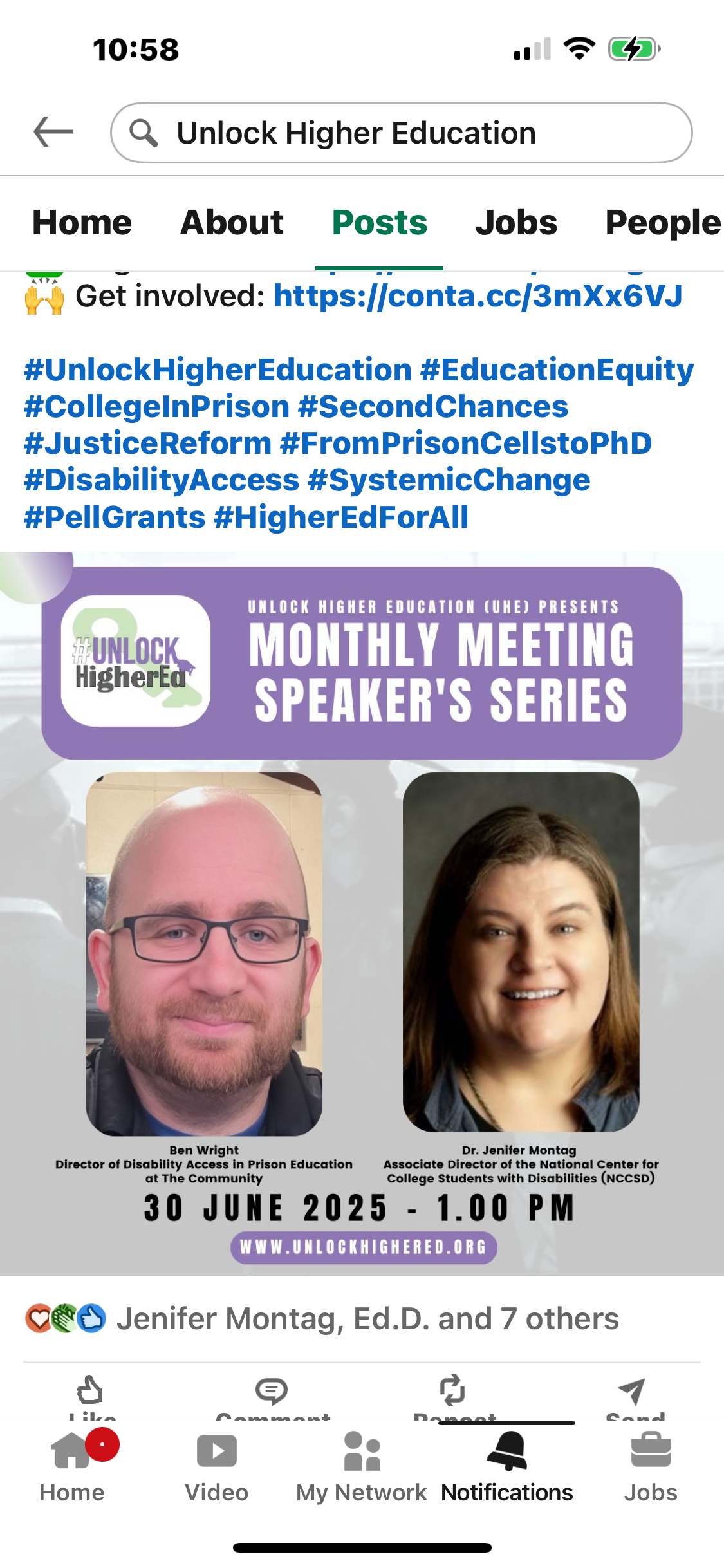
See you on the 30th (next Monday) at 1pm for our talk with Unlock Higher Education ! Register here :)


Tuesday, June 17, 2025

Beyond the Numbers: What JFF’s Horizons Conference Means for Prison Education and Reentry


Photo credit: Rebecca Villarreal


Hi all!

Part of my job at The Community is to correspond with individuals who are incarcerated in the state of Wisconsin. I also communicate with several people from Ohio. While this began as part of my Communications role, I chose to continue this work even after transitioning into my current position as Director of Disability Access in Prison Education.

Many of the people I write to express feelings of hopelessness: “I can’t do it,” “There’s no hope for me when I get out,” and so on. And honestly? I get it. I don’t always know what to say. The statistics are discouraging. According to one study, about 39% of people incarcerated in state facilities return to prison within three years. Only 40% of formerly incarcerated individuals have gainful employment (though I often wonder how “gainful” is actually defined). One study out of Cornell reported that 66% of incarcerated individuals self-report having a disability. The numbers vary depending on the source, but the overall picture doesn’t look promising.

So how do we respond? How do we encourage people who are staring down numbers like that—people who have been incarcerated for 15 or even 20 years, preparing for release with little to no family left, few financial resources, and no clear direction?

How do we offer hope without sounding like a cliché? “Don’t give up!” “Try hard and you’ll succeed!” “Good things come to those who wait!” These statements, while well-meaning, often fall flat. On the flip side, I don’t want to be a Debbie Downer either.

Last week, I had the opportunity to attend the Horizons conference hosted by Jobs for the Future (JFF). JFF has a division called the Center for Justice and Economic Advancement (CJEA), which is committed to breaking down systemic barriers and advancing fair chance employment for people with criminal records. JFF is also doing groundbreaking work around AI, North Star credentialing, and more. I’m continually impressed that they boldly and publicly support CJEA, even when so many organizations still shy away from justice-focused efforts.

During a main stage session with over 1,500 attendees—from institutions, nonprofits, corporations, and more—JFF proudly highlighted CJEA and invited Molly Lasagna, Susan Burton, Lucretia Murphy, and Darvelle Hutchins to speak. These four are giants in the field. I’ve admired Susan and Molly’s work for years, and Lucretia and Darvelle are true pioneers. If you don’t know who they are, take a moment to look them up—you won’t regret it. I got to buy Susan's book, too! 

In addition to the main session, I attended breakouts focused on fair chance employment, including one with a representative from the Port Authority (yes, the one known for its rigorous security checks) and a professor from Belize doing powerful comparative work. JFF also introduced seven ambassadors from CJEA, all formerly incarcerated individuals now leading in their fields.

I’ll be honest—there were moments I felt like a fish out of water. I felt that way last year, too. But here’s what I’ve realized: I belong there. I was in that room with governors, CEOs, university administrators, and yes, folks like me. I attended sessions on AI, disability, and justice just like the executives sitting next to me.

I’m especially grateful to Rebecca Villarreal and Jenna Dreier, whose passion for this work is unmatched. JFF backs up their values with action. They’ve even hired Shaun Libby, a currently incarcerated individual, as a manager on staff. They’ve made it work—despite the challenges—and most importantly, they’ve treated him like an equal member of the team. He’s building savings. When he comes home, he won’t be starting from scratch.

One of my personal heroes is Dolly Parton, and her words feel relevant here:

“If your actions create a legacy that inspires others to dream more, learn more, do more, and become more, then you are an excellent leader.”

That’s exactly what CJEA is doing.
They empower people to dream more by showing them a future is possible.
They help us learn more by educating the public and stakeholders.
They equip people to do more by building networks and hiring directly from impacted communities.
They help others become more by producing results—not just rhetoric.

Do you see where I’m going with this?

When incarcerated individuals write to me, I want to point to something real—something tangible, something practical. Instead of saying, “If I can do it, you can too,” I want to say, “Look at what JFF and CJEA are doing. There’s a model out there. There’s hope—and here’s what it looks like in action.”

And that’s what I hope to accomplish with our disability access project too. I want to be able to say, “Here’s what we’re building for you. Here’s how we’re creating access to education and employment.” Everyone deserves the chance to be an engaged, contributing member of their community. This is how we start.

Also—on a lighter note—I had an amazing time in New Orleans! We went on a riverboat, took a swamp tour (airboats are wild!), explored the French Market, and of course, wandered up and down Bourbon Street. If you go, take a riverboat tour—you won’t regret it!

To Molly, Susan, Darvelle, Lucretia, Rebecca, Jenna, Linette, Maria, Michael, Shaun, and so many others I’m forgetting to name here—thank you for making Horizons such a rewarding and revitalizing experience.

Colorado, Correspondence Courses, and the Difference Between Access and “Access”

  I want to start with a quick apology: I haven’t posted in a while. Lately, my energy has been fully tied up in Stop the Stigma planning—an...